







News · UCJC · Innovation and Entrepreneurship
Ágora 2026 champions leadership that combines excellence, competitiveness and care for people at UCJC
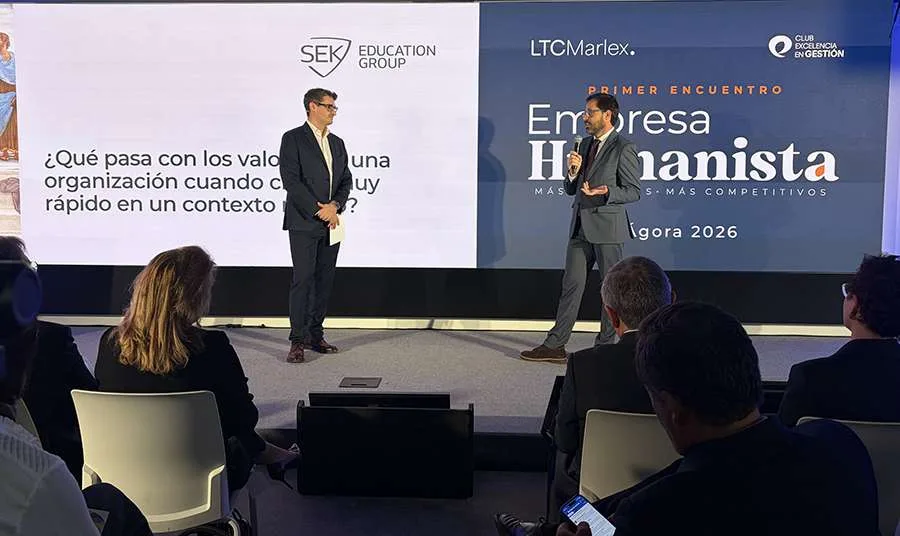
Camilo José Cela University hosted Ágora 2026 Empresa Humanista: More Human. More Competitive, an event that brought together representatives from organisations across different sectors to reflect on a new approach to business management, one that combines competitiveness and excellence with respect, care and the development of people.
Held at Camilo José Cela University’s Castellana Campus and organised by Club Excelencia en Gestión and Marlex, the event marked the official launch of Empresa Humanista, an initiative in which SEK Education Group is one of 14 founding organisations.
Far from being limited to theoretical discussions, the event focused on the everyday decisions made by organisations and the challenges facing their leaders in a context shaped by technological transformation, artificial intelligence and the changing expectations of professionals and society. SEK Education Group shared its vision of humanistic education and presented SEK-Riyadh’s experience of values-based management.
Drawing on real-world experiences, the participating organisations explored how to translate humanistic principles into their management models, particularly when making complex decisions, driving cultural transformation or striking a balance between organisational performance and employee wellbeing.
Xavier Marcet: care and high expectations as complementary principles of leadership
One of the event’s leading speakers was Xavier Marcet, a driving force behind the Humanistic Management movement, who advocated an approach to leadership that rejects the idea that competitiveness and wellbeing are opposing priorities.
During his presentation, Marcet emphasised that humanistic business management does not mean avoiding difficult decisions or placing care for people above every other consideration. Instead, it involves integrating high standards, responsibility and respect into the way organisations are managed.
His reflections placed a fundamental question at the heart of the debate: results matter, but so does the way they are achieved. From this perspective, humanistic leadership requires organisations to create value and remain competitive without losing sight of people’s dignity and professional development.
Artificial intelligence also featured prominently in his presentation. Marcet highlighted the need to move beyond the perceived opposition between technology and humanism and develop new ways of working in which innovation strengthens human judgement, talent and autonomy.
Along similar lines, Ignacio Babé Romero, Director General of Club Excelencia en Gestión, stressed that technological transformation requires organisations not only to review their management models but also to strengthen critical thinking and sound judgement. His reflections highlighted the importance of placing purpose, culture and people at the centre of decisions about how technology is used.
Nieves Segovia: education as an expression of humanism
The educational dimension of this debate was present from the opening remarks delivered by Nieves Segovia, President of SEK Education Group, who highlighted the significance of holding the event at a university and recalled the close relationship between education and humanism. “We are, by our very nature, a humanistic educational organisation, because education can be nothing else,” she stated.
Segovia reflected on the profound transformations taking place within organisations and the impact of artificial intelligence on the ways we learn, work and access knowledge.
Against this backdrop, she emphasised the importance of nurturing the capabilities that distinguish us as human beings and harnessing the opportunities offered by technology to devote more time and attention to people, particularly when supporting students throughout their learning and personal development.
This vision is closely aligned with the SEK educational model, which places students at the centre of learning and promotes the development of skills such as critical thinking, creativity, collaboration and adaptability. This approach sees technological innovation as an opportunity to expand educational possibilities and foster holistic human development.
From this perspective, humanism is not merely a management principle but also an educational conviction: preparing new generations for a changing world requires the development of knowledge and skills, alongside autonomy, sound judgement and responsibility.
SEK-Riyadh: translating values into management decisions
SEK Education Group’s participation also included a presentation by Iván Martínez, Director General of SEK International Schools, who shared the experience of SEK International School Riyadh as an example of how the principles of humanistic leadership can be applied to the management of an educational organisation.
The case study, featured in the Empresa Humanista publication under the title When Values Guide Difficult Decisions, addresses one of the main challenges facing growing organisations: strengthening their structures while remaining consistent with their institutional principles.
In just six academic years, SEK-Riyadh has grown from 36 to 900 students and from 20 to more than 120 professionals. This growth made it necessary to develop new processes for organisation, evaluation and staff support, while preserving the school’s identity and values.
To address this challenge, the school introduced a process involving its entire workforce, designed to assess professional competences, suitability for the responsibilities of each role and commitment to institutional values.
The initiative translated five fundamental principles — collaboration, continuous improvement, adaptability, commitment and care — into observable behaviours and specific criteria to guide decisions on leadership, responsibilities and professional development.
In this way, the school turned its values into a practical management tool, demonstrating that care for people and high professional standards can reinforce one another when decisions are made according to clear criteria, transparency and respect.
This experience reflects one of the core convictions of the SEK educational project: excellence in student learning is closely linked to the professional development and wellbeing of those who support them. For this reason, the Institution promotes a culture of lifelong learning, collaboration and continuous improvement, in which professionals actively contribute to the evolution of its educational model.
A community of organisations committed to a different approach to management
Throughout the event, representatives from organisations in sectors including education, healthcare, industry, services and transport shared experiences of cultural transformation, talent development, employee wellbeing and adaptation to emerging technological challenges.
Case studies presented by organisations such as MAPFRE, Renfe, ILUNION, Pascual and SEAT demonstrated how humanistic principles can be applied in very different business contexts, from supporting people in vulnerable situations to technological transformation processes and the development of new leadership models.
The various contributions converged on one fundamental idea: a humanistic culture is not built through statements of principle alone, but through the decisions organisations make and the impact those decisions have on people.
The launch of Empresa Humanista therefore marks a starting point for building a community of organisations united by a shared commitment to developing more responsible, sustainable and people-centred management models, without compromising excellence or performance.
For SEK Education Group, its participation in this initiative represents an opportunity to contribute to the conversation about the future of leadership, drawing on its educational experience and its commitment to innovation, talent development and the wellbeing of its students and professionals.
With more than 130 years of history, the Institution shares a vision in which excellence and humanism are part of the same purpose. This conviction is reflected both in the way it supports students throughout their learning and in how it manages and develops its professional teams: the progress of organisations should not be measured solely by the results they achieve, but also by their ability to help the people who make those results possible grow and develop.
- Innovation and Entrepreneurship
- UCJC
Published on 28 October 2026 Last updated: 30 October 2026